

Your old coins lose their value on 1 November: what you need to know
From 1 November 2026, “old range” coins issued between 1958 and 1985 can no longer be used to pay in CEMAC. You have one year to exchange them. Which coins, where, and until when.
Translated from French. Lire en français
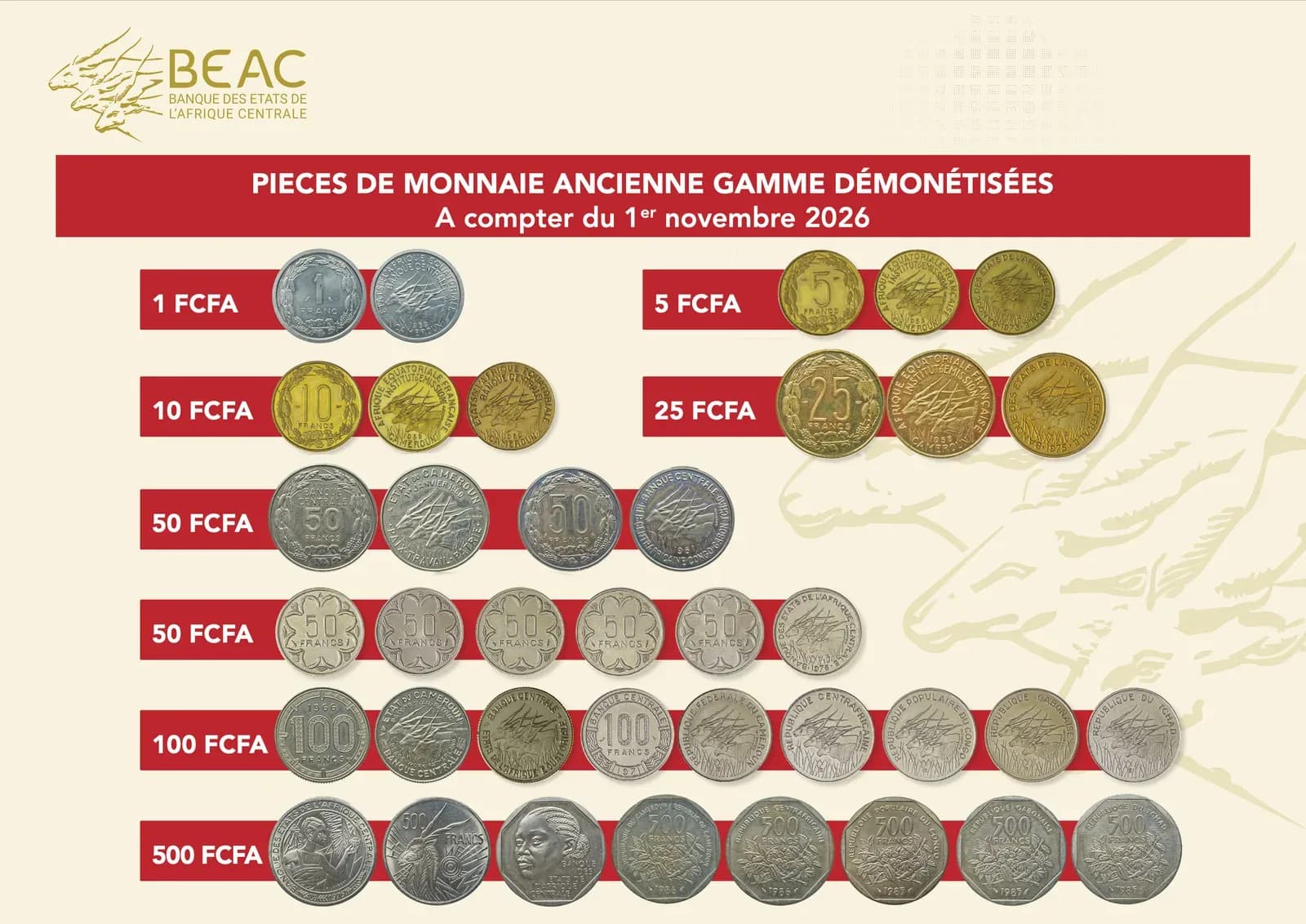
It is now a matter of days. From 1 November 2026, the “old range” coins put into circulation by the BEAC between 1958 and 1985 lose their legal tender status in Chad and in the five other CEMAC countries. In practice, nobody will be obliged to accept them for a purchase or to settle a debt. But they do not become worthless overnight: holders have one year to exchange them for valid coins.
A decision taken in N'Djamena
The measure was adopted in the Chadian capital. On 5 October 2026, the BEAC board of directors, meeting in N'Djamena, proposed withdrawing the old coins. Two days later, on 7 October, the Ministerial Committee of the Central African Monetary Union (UMAC) approved it. BEAC Governor Yvon Sana Bangui set out the timetable in an information note dated 8 October.
The stated aim is to “simplify the currency landscape by withdrawing old, worn and disparate coins, as coins from the 2024 range are being rolled out on a large scale”, according to the statement issued after the meetings. The new “type 2024” range, launched on 2 April 2025 in Bangui, has nine denominations from 1 to 500 FCFA, including a new 200 FCFA coin. The central bank plans to put around three billion of them into circulation by 2030 to end shortages of small change.
Which coins are affected?
All old-range coins minted between 1958 and 1985, in denominations of 1, 5, 10, 25, 50, 100 and 500 FCFA. They can often be recognised by older inscriptions such as “Afrique équatoriale française”, “État du Cameroun” or “Banque centrale”, or by the name of a single country (“République du Tchad”, “République gabonaise”…) struck on the coin.
Note: it is the range that matters, not the value. A 100 or 500 FCFA coin is not necessarily affected. The BEAC has published an official poster showing each withdrawn coin; it is the reference to check in case of doubt.
Still valid, with no time limit: coins from the 2006 range and the 2024 range. The Governor's note is explicit: they “must, as such, be accepted in transactions of all kinds”.
Where and until when can they be exchanged?
The exchange takes place in two stages:
- 1 November 2026 to 31 July 2027 (9 months): at the counters of banks, microfinance institutions and the BEAC.
- 1 August to 31 October 2027 (3 months): only at BEAC counters. In Chad, that means the N'Djamena branch and the central bank's other offices in the country.
- From 1 November 2027: no exchange possible at any counter. Coins not exchanged by then will have no value.
Old coins are exchanged for coins from the 2006 or 2024 ranges. The BEAC says practical arrangements (opening hours, quantities, any forms) will be set by each bank, each microfinance institution and by the BEAC itself. It is therefore best to check with your branch before turning up with a bag of change.
Until 31 October, these coins remain legal tender
Elsewhere in the zone, the announcement has caused confusion that is costly for the poorest. In Cameroon, local media have reported since mid-October taxi drivers, cashiers and pump attendants already refusing old coins, and sometimes even perfectly valid 100 or 500 FCFA coins. In Gabon, some traders have ended up refusing all coins as a precaution.
Chad knows this scenario well: in 2022, 500 FCFA coins were rejected by users in Pala, prompting the BEAC to publicly remind people that they were legal tender.
A useful reminder: until 31 October 2026 inclusive, old-range coins must still be accepted. And after that date, only those old coins may be refused. Refusing a coin from the 2006 or 2024 range has no legal basis.
Key points
- 1 November 2026: old-range coins (1958–1985) are no longer legal tender.
- Until 31 July 2027: exchange at a bank, a microfinance institution or the BEAC.
- Until 31 October 2027: exchange at the BEAC only.
- 2006 and 2024 ranges: still valid and must be accepted everywhere.
- If in doubt: compare your coin with the BEAC's official poster, available on beac.int.
Sources: BEAC Governor's information note of 8 October 2026; statements from the BEAC board of directors (5 October 2026) and the UMAC Ministerial Committee (7 October 2026); Investir au Cameroun, Gabonreview, 237online, Tchadinfos.
- Published on:
- Wednesday, 28 October 2026
Related articles

B- rating confirmed: what S&P and Fitch say about Chad
Rating agencies Standard & Poor's and Fitch Ratings have kept Chad's sovereign rating at B-, with a stable outlook. What does this decision mean for the country and its businesses?
Chad in the era of gender promotion
Parity ordinance, laws against violence, girls’ education: an analysis of legislative progress and persistent challenges.

Total opens new service stations
With three new stations in Hamama, Bongor and Ndjari, Total Marketing Chad brings its network to 12 stations, with 16 targeted by year-end.
Chad: emergence via the information superhighway
The first International ICT Fair (SITIC), held in N’Djamena from 9 to 12 September 2014, brought together many heads of state and international institutions.